Wednesday AM, we get breakfast. We have a plan though, and load up on a bunch of goodies from you-know-where.

Sammie is eating her favorite, Baum kutchen, purchased at her favorite place in Tokyo Station. It's pretty expensive, about ¥1,000 for a small slice that would feed one hungry dessert eater.

We take the Hashidate limited express train, which goes from Kyoto to Amanohashidate, with no transfers. Part of the trip goes on a private railway track, so there is a supplement that is needed to be paid, beyond the JR Pass. I have read about the Kyoto Sea Pass, which allows unlimited rail passage on the private tracks on unreserved seats (but supposedly covers reserved seats if using a JR pass with seat tickets), a boat ride to the Amanohashidate peninsula, bicycle rentals (we were going to forego this in the interest of time), chair lift or cable car rides to Kasamatsu Park, where you can get a really nice view (this is the preferred view of Amanohashidate). But the train conductor says the pass is not sold on the train, contrary to the brochure and the Kyoto Sea Pass website. Anyway, I still haven't figured out whether the Sea pass covers the extra distance, because on the return trip from Amanohashidate to Fukuchiyama (the gateway to the Tango Peninsula) the conductor told me in Japanese some stuff about the pass and our seats, and said in broken English, "that's ok," as though he was giving us a break (the supplement wasn't trivial -- it would have been about ¥1400 per person on each of the two legs that we took).
Anyway, that is likely way more information than anyone reading this is interested in, except for OCD people like me. Besides, you're thinking, what the $%&# is this Amanohashidate thing anyway, and why are we making such a trip out of the way to see it?
It is erroneously thought that Japan's three great views, Itsukushima, Matsushima, and Amanohashidate, were attributed to the famous Haiku writer, Basho. In fact, it isn't known with certainty who really thought of this. It might have been attributed to Hayashi Gaho. These three views are certainly beautiful.
Amanohashidate is a strip of sand that connects the two sides of Miyazu Bay. It is about two miles long, and there are very old pine trees that grow along the strip. It is a unique geographical "thing." It is said that if you go up to one of the two peaks on either side of Amanohashidate, and bend over and look backwards between your legs, it appears to be a "bridge to heaven."
We have a trek before us. We arrive at the station, then purchase the Sea Pass that we were supposed to use for the supplement for the prior train ride (honor system, I guess), then use the pass for the 12 minute boat ride across the bay, alongside the "bridge to heaven."
On board, on the upper level, I spy a bunch of seagulls flying in sync with the boat. I figure it is because they're fed by the passengers, and then I also figure out that some red packages on the wall (with a ¥100 honor system box) contain seagull food. The others are afraid of the seagulls (you know what they do do), so I am alone out there. I'll post a video later, since we are so busy (I'm writing this on the Shinkansen on our last day in Japan).


We walk from the other pier to the bottom of the chair lift. Connie really wanted to ride the cable car, but it only went up once every 15 minutes, and I was on a strict timetable, so she reluctantly says ok to the chairlifts, which have no line at all. Along the walk, there are preserved puffer fish (Fugu) for sale (only for show, not to eat).

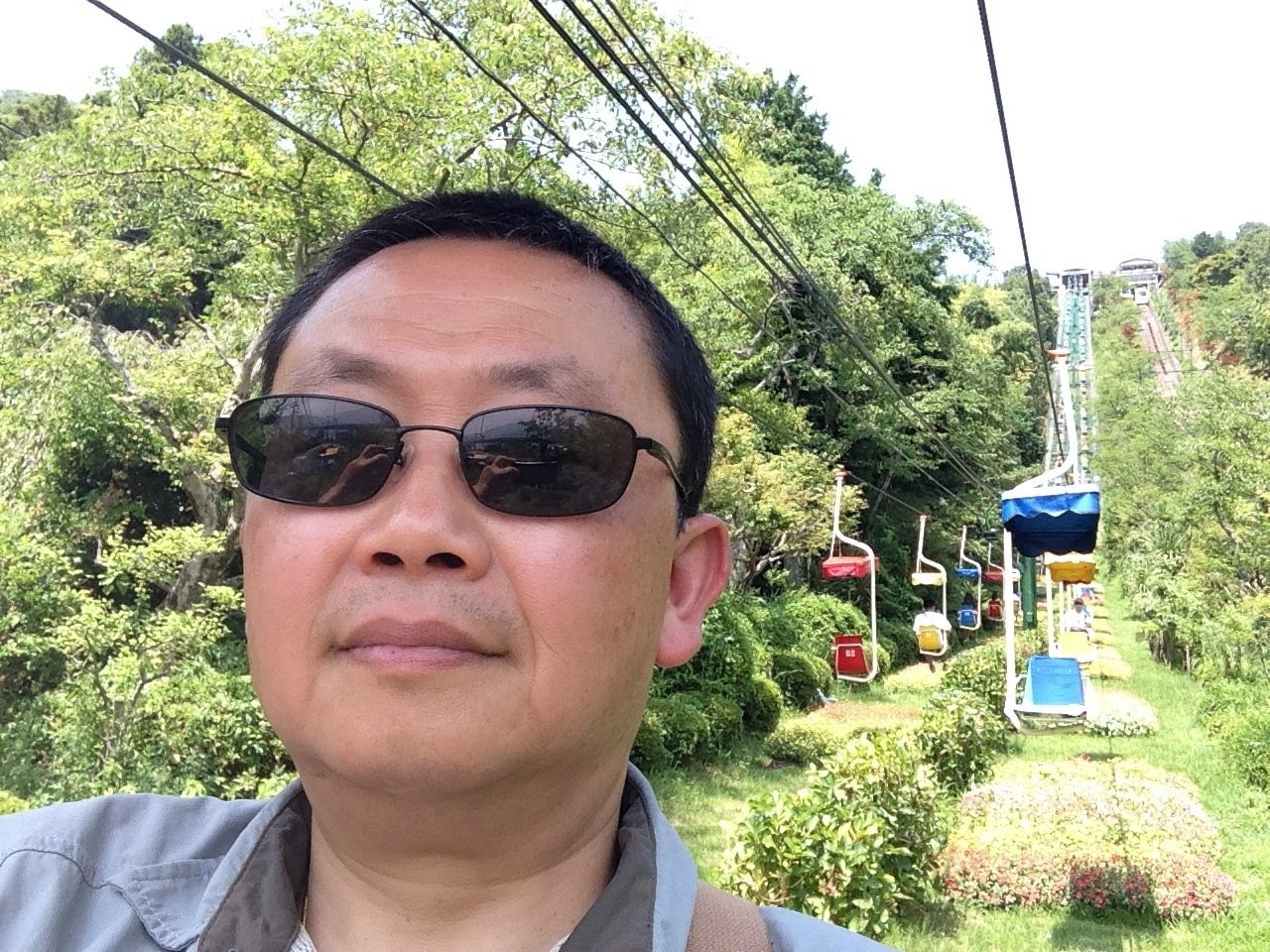
Here's the chair lift with Sam.

Here is Amanohashidate. It is really pretty and unique.

Connie doing her thing.

Em doing her thing.

Here's a panoramic view. Click on the photo to see it in all its gory detail

Chairlift down.


Here's me.
So, we take another couple of trains from Amanohashidate to our next destination, Kinosaki Onsen. This is a famous Onsen town on the Japan Sea coast, about an hour and a half from Amanohashidate. I had read about this onsen town for several years. There are seven public Onsen baths in town, each charging several hundred yen for admission (but most ryokan have deals with them for free admission). I got a good deal on Japanican for one of the best ryokan in town, Nishimuraya Honkan.
On arrival in the station, a nice young woman approached us and asked us to board a shuttle to the ryokan. I had read that this would happen automatically, but wasn't sure how it actually occurred. Anyway, we were slow getting out of the train with all our luggage (travel light in Japan is my main recommendation to anyone), and the first shuttle was full, and we had to wait about 10 to 15 minutes for the next one. We were among the only ones on the subsequent shuttle, and we got the short 5 minute drive from the small station to our ryokan. One of the men already knew my name as soon as we exited the shuttle bus.
We went through the standard take off shoes, register briefly, show passports, and then arrive in a very spacious room. There was the standard window room with four chairs and a table, and an anteroom-like side room, in addition to the main sleep and dining room. I must be old, because my legs cannot really handle this kind of sitting for too long. Anyway, we rested for a short time and I decided to check out the onsen in the ryokan. This ryokan has two moderately large onsens, which alternate from women and men every day, so you'd have to go morning and evening to take advantage. It was really nice, though I had to do it quick before our dinner.
Our dinner was the typical multi-course affair.
Started with a Shiso Sake (with the red color). I tasted little alcohol in it, though it wasn't served to Sam and Em. It was refreshing.
Here is our second course, with pickled eggplant in the shape of a hyotan, pickled kabocha, taro with miso on the left. Umisomen on top, in a okra - dashi sauce on top, and shrimp, Ayu, and renkon-mustard on the bottom. I especially liked the potato like renkon with mustard stuffed into the holes in the middle. It was starchy, but not overly so.

I don't usually like Ayu, but I am a trooper below.

Umi Somen.

Next course, was shiso somen with cucumber and tofu in yuzu sauce.

Next is the Sashimi course, with, from left to right, sea bass, turban clam, and kampachi.


Next, a seaweed and tororo mixture. Also a bit over the top. Pickled squid on the right.

Mmmm. Meat course. Tajima beef (cattle used for Kobe beef), maitake mushrooms, some bean sprouts and vegetables.


Here is the presentation of the rice dish (the end). It was brought in in a copper pot over a flame. You can see the water level here. Just light, cover, and return later.

Assorted summer vegetables as our next course. Clockwise from lower left, radish, grilled corn (very very sweet), tomato, cucumber, okra, all with a miso dish served with an Uri Geller spoon.

Here is our tajima beef. This portion was a bit overcooked. But the other portions are more rare. These are very tender pieces of beef!

Abalone, togarashi (fresh), and potato.


Eggplant, with mushrooms, with a simmered fish.

Our simmered, steamed rice.

Rice served with tsukemono

Relaxing in between courses.

Dessert, a tomato and kanten in sweet vinegar. It was challenging eating this as a dessert.

After dinner, we go out and Onsen hop. We went to one called Goshounoyu. Large, and one of the newer ones. It was hopping inside. We met up afterwards for a photo.


We went to Ichinoyu, but it was closed, so we had an ice with Macha for dessert, and called it a night.
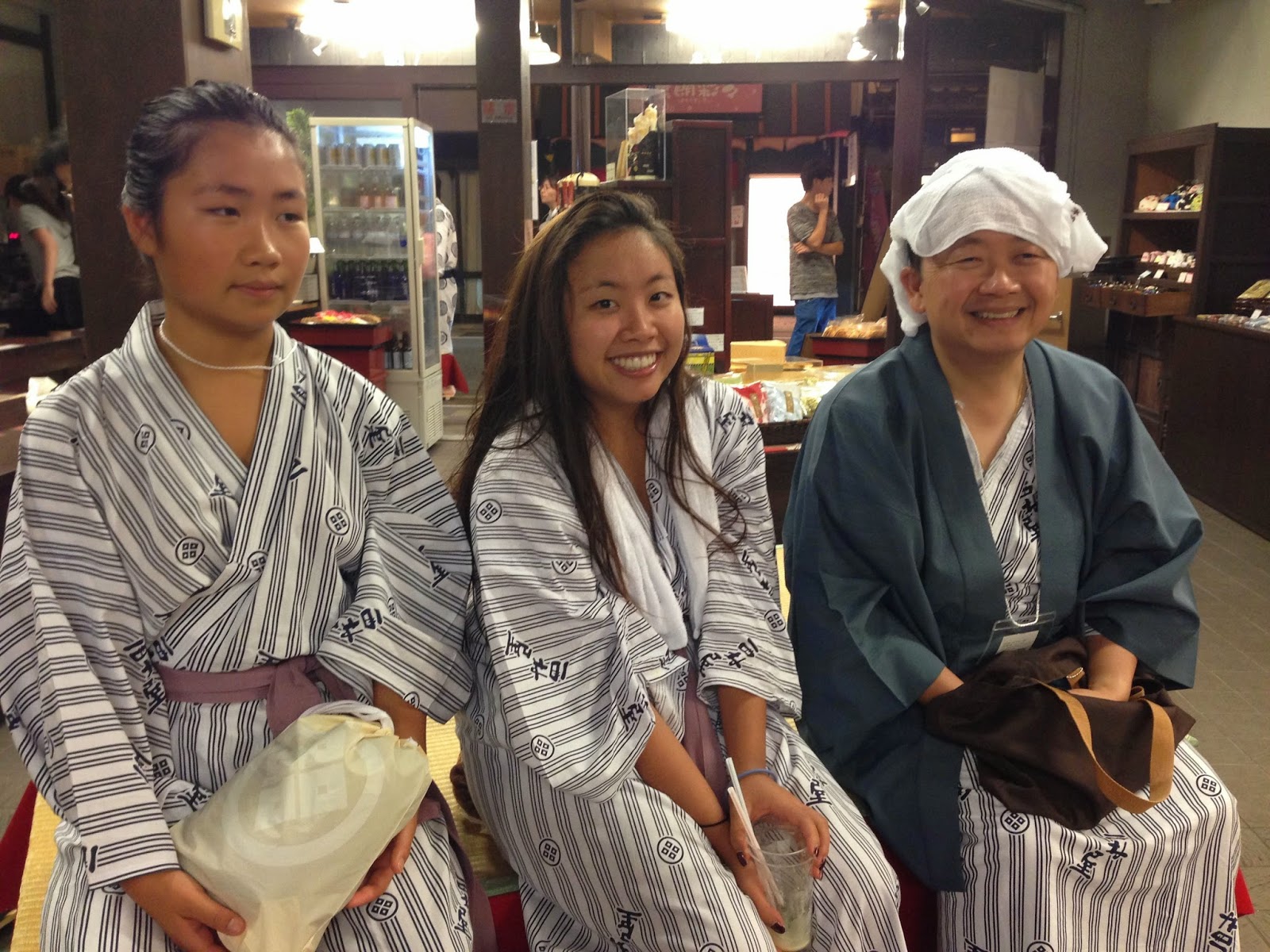
The next morning, before breakfast, we went to another onsen called Konoyu. Here we are walking along the street. Much less crowded in the AM.


Breakfast for us. Grilled fish. Miso soup with tofu, small veggie plate, egg, tsukemono.


Here is the little tag that we wear in a neck lanyard. This is scanned and allows free access to the onsen from ryokan goers.

Walking through Kinosaki town.


It's a really quiet town. I'm sure beautiful in April with the Sakura.

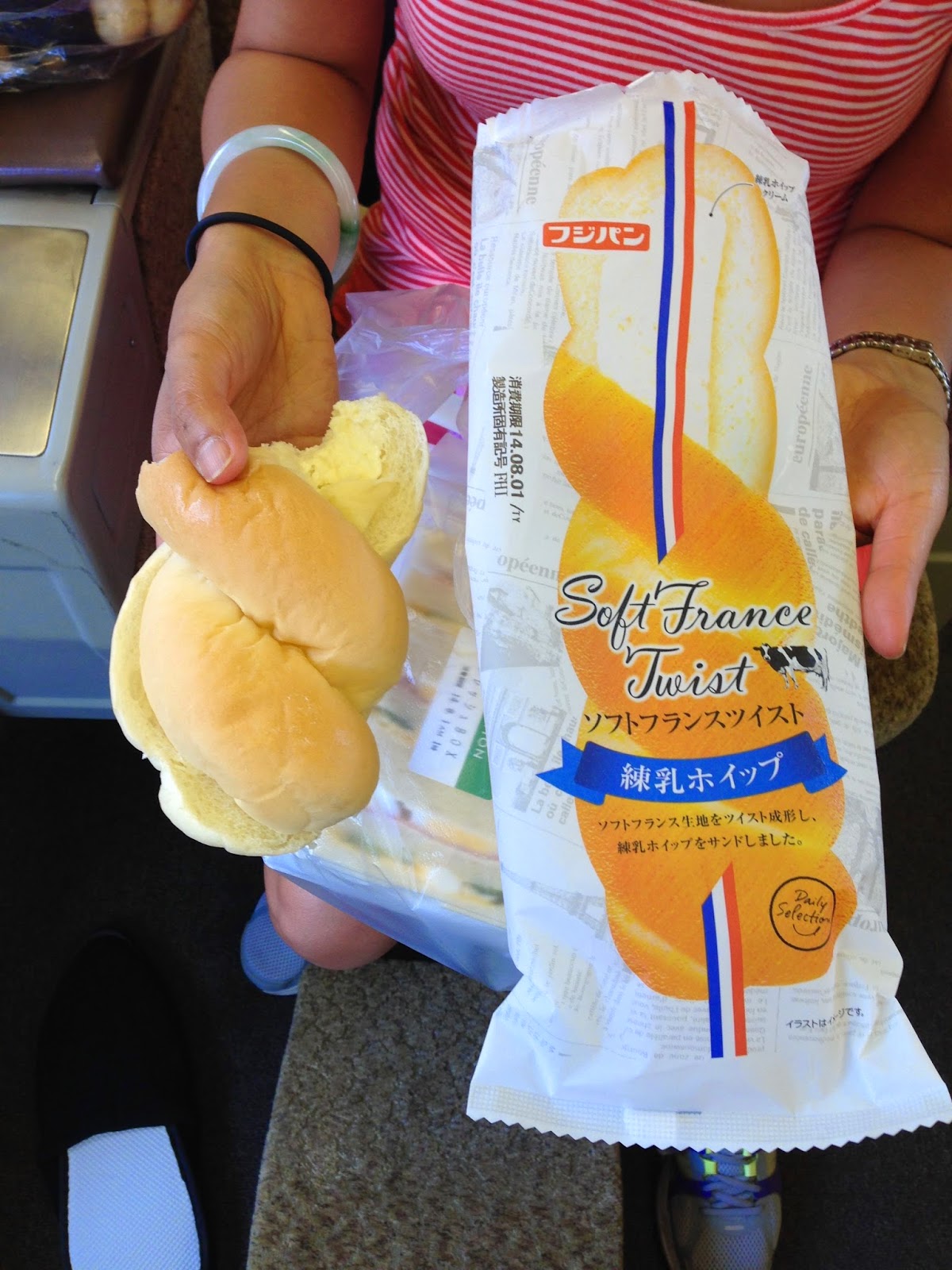
We're taken to the station in the Ryokan car, and along the way, I spied a grocery store to get some food for our train ride. Connie and the kids go, while I watch our luggage at the station (we have a half hour). she finds a France Pan - like imitation which wasn't bad at all!
This is Em's lunch!

Sammie's udon bento box.

Along the way, from the train.

I get an Ume onigiri (love 'em), and a sandwich. Note my drink. Select bottles of tea come with a free Rilakumma terry cloth cover to help reduce condensation.

Going to Onoshima this day, in preparation for our trip to Ookunoshima.


